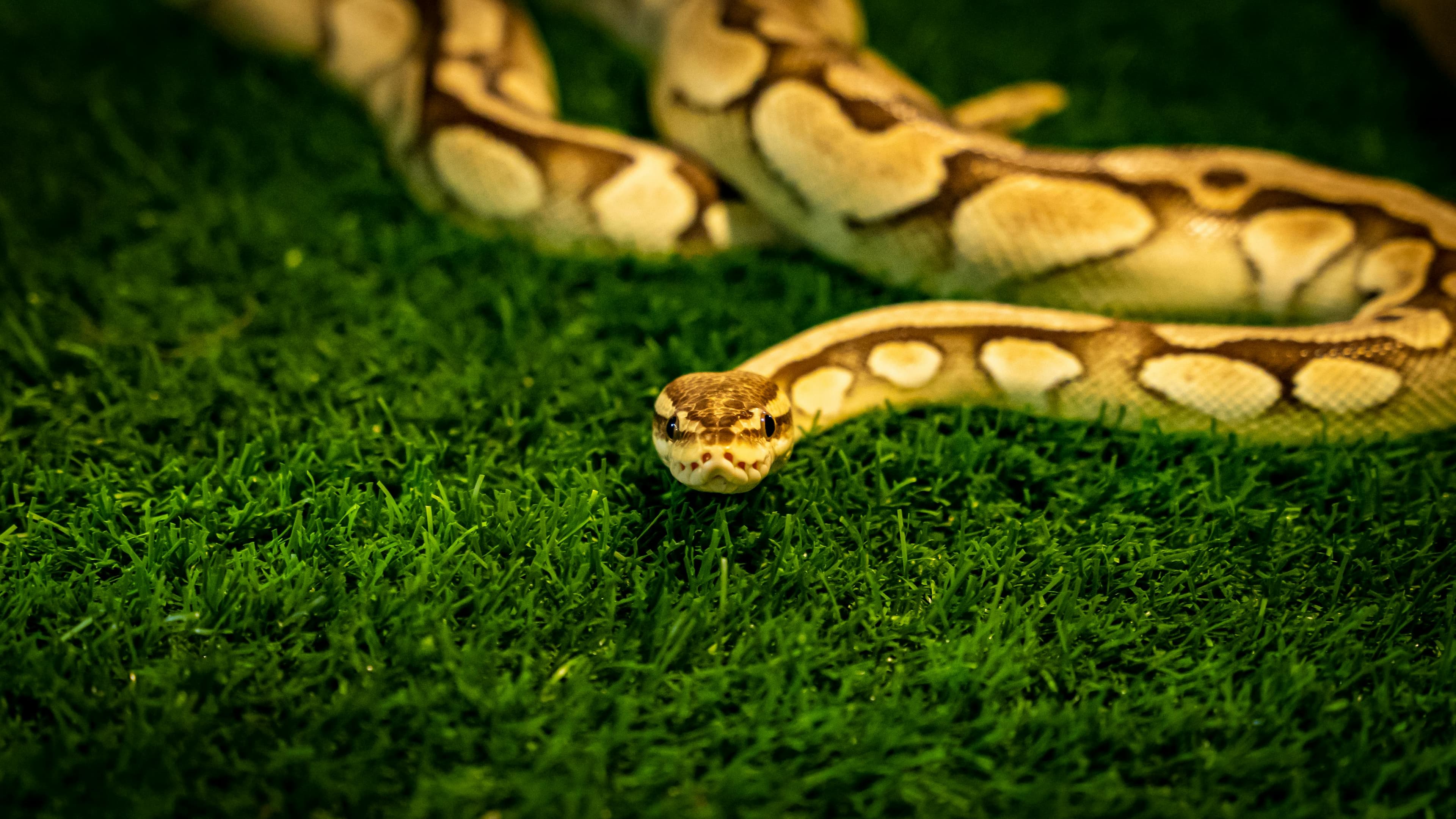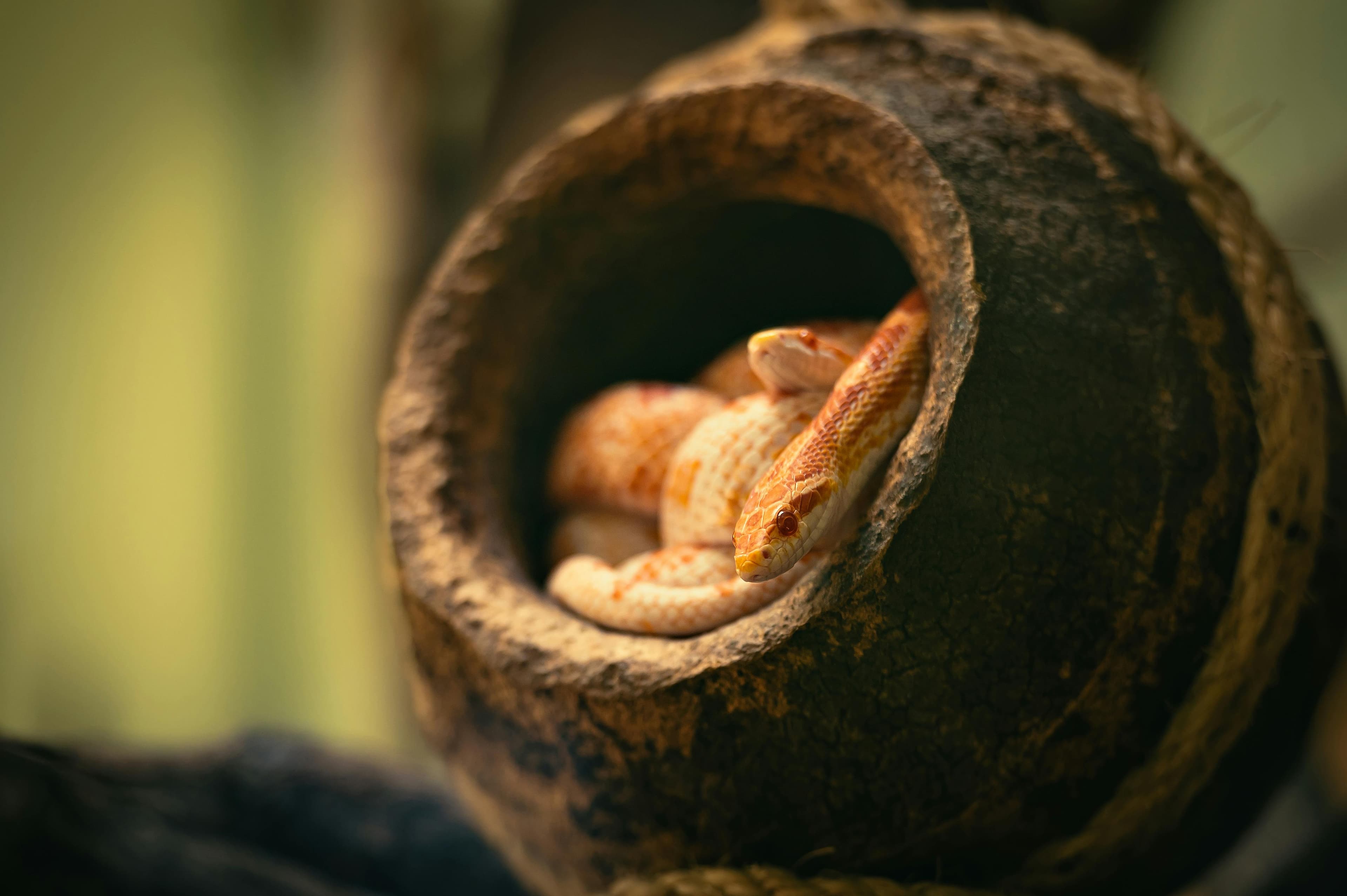
corn snake
Pantherophis guttatus
a temperate, day-active colubrid from the south-eastern us. active, hand-tolerant, prolific escape artist.
photo on pexels
difficulty
beginner
adult size
90–150 cm, 500–900 g
lifespan
15–20 years (some 23+)
origin
pine barrens, scrubland, and farmland of the south-eastern united states
00 / overview
about
corn snakes are diurnal-to-crepuscular colubrid snakes from the south-eastern united states. they are active, alert, and curious, which is why most modern keepers consider them a better "first snake" than ball pythons. they are reliable eaters, calm-to-friendly with handling, and tolerate a wide range of temperatures.
what makes them a reasonable first snake: predictable feeding response, manageable adult size (around 1.2 m typical), broad temperature tolerance, no humidity headaches like ball pythons. what trips first-time keepers: escapes. they are exceptionally good at finding any gap in a screen top or sliding glass door, and once out can be hard to find. a secure, locking enclosure is non-negotiable. the second-most-common rookie problem is feeding the wrong-size prey: too small and the snake regurgitates from a feeding response with nothing satisfying, too large and the snake regurgitates from sheer mass.
read the husbandry block below. every line is load-bearing.
01 / setup
enclosure
- type
- pvc
- minimum dimensions
- 120 × 45 × 45 cm
- substrate
- aspen shavings, cypress mulch, or paper substrate. aspen is the keeper favourite (dry, lets the snake burrow, holds shape). no cedar, no pine.
120 × 45 × 45 cm (4 × 1.5 × 1.5 ft) is the floor for a single adult. 120 × 60 × 60 cm (4 × 2 × 2 ft) is the modern keeper standard. pvc or front-opening glass with a secure locking lid is mandatory. corn snakes are infamous escape artists, any gap larger than the snake's head is an exit. provide two hides (warm and cool side), a small climbing branch (corn snakes are semi-arboreal), and a water dish large enough to soak in but not deep enough to drown a juvenile.
02 / climate
temperature, humidity, uvb
temperature
cool side
22–24°c
warm side
28–30°c
basking
31°c
night drop to
20°c
humidity
40–60%
uvb
- bulb
- arcadia shadedweller pro t5 7 % or zoo med reptisun t5 ho 5.0, 50 % length of tank
- target uvi
- 2
- photoperiod
- 12 h / day
use a thermostat-controlled radiant heat panel or low-wattage halogen bulb on the warm end. never use an unregulated heat mat. measure warm-side surface temp with an infrared thermometer. uvb is increasingly endorsed (ferguson zone 1, uvi 1–2 at basking) and is no longer considered optional. raise humidity to 60–70 % briefly during shed cycles, via a humid hide with damp sphagnum or light misting. ambient temp can drop to room temp at night, no heat needed below 18 c is fine.
03 / nutrition
diet
feeders
- frozen-thawed pinkie mouse (hatchlings)
- frozen-thawed fuzzy mouse (juveniles)
- frozen-thawed hopper mouse (sub-adults)
- frozen-thawed adult mouse (adults)
- frozen-thawed jumbo mouse or weanling rat (large adults)
feeding frequency
hatchlings under 6 months: pinkie f/t every 5–7 days. juveniles 6–18 months: fuzzy to hopper mouse f/t every 7 days. adults 18+ months: adult mouse f/t every 7–10 days. prey item should be ~1.25× the widest part of the snake's body, leaving a visible bulge after the meal that smooths out in 24–48 hours.
frozen-thawed only. live prey can injure or kill the snake; the rule applies even more strictly to corn snakes than ball pythons because corns are smaller. thaw in the fridge overnight, then warm in a sealed bag in warm water to ~37 c (body temperature of a live rodent) before offering with feeding tongs. never microwave. feed in the enclosure; the "feed in a separate tub" advice is outdated and stresses the snake. do not handle for 48–72 h after a meal.
04 / interaction
handling
frequency
3–4× per week, 10–20 min sessions, once habituated. give a new snake 1–2 weeks of minimal disturbance and at least one successful feeding before any handling.
no handling for 48–72 h after a meal, risk of regurgitation. no handling during a shed cycle (eyes go opaque "blue"). support the body in two places, never grab from above. corn snakes are typically calm but hatchlings can be nippy from food response, a bite is harmless and superficial. wash hands before handling to remove any rodent scent (rodent-scented hand = strike target). signs to put the snake back: musking, rapid retreat into your sleeve, or hiding.
05 / seasonal
brumation
optional for pet animals, useful for breeders. corn snakes in the wild brumate from late autumn through early spring. captive brumation: drop ambient temps to 10–13 c for 8–12 weeks (late october through february), keep water available, do not feed, weigh weekly. only healthy adult animals at peak weight should brumate, never juveniles, never underweight or sick animals. pet corn snakes do fine without brumation, kept at year-round temps. a snake that naturally slows down and refuses food in autumn is signalling brumation; respect it if the snake is otherwise healthy.
08 / red flags
common health issues
respiratory infection (ri): from chronic low temps or extended high humidity. signs: mucus around nose or mouth, open-mouth breathing at rest, audible wheeze or click, lethargy. requires an exotic vet, usually antibiotics. corn snakes are more tolerant of brief humidity spikes than ball pythons, but persistent damp substrate is still a problem.
regurgitation: most common rookie issue. causes: handling within 48–72 h of a meal, prey too large (rule of thumb: prey ~1.25× the snake''s widest point), ambient temps too cool to digest, stress from cage moves or vibration. signs: undigested or partially digested rodent expelled 2–4 days post-feeding. the gut lining is damaged, wait 7–10 days, offer a smaller prey item, do not handle for 72 h post-feeding.
scale rot: prolonged contact with damp substrate or feces. signs: reddened or blistered belly scales, blackened patches. fix substrate moisture immediately, see an exotic vet for any open lesions. corn snakes are not humidity-loving, keep substrate dry except in a humid hide during shed.
dysecdysis (stuck shed): low humidity during shed cycle. signs: patchy shed in pieces, retained eye caps (spectacles), retained tail tip. fix: provide a humid hide with damp sphagnum moss during shed, raise overall enclosure humidity to 60–70 % briefly, soak in shallow lukewarm water if needed.
mites (ophionyssus natricis): tiny black or red specks around the eye pits, under chin scales, in the water dish. cause anemia and transmit ri. treat with provent-a-mite or vet-prescribed alternative, quarantine new snakes 90 days minimum before any introduction to an existing collection.
egg-binding (dystocia) in females: gravid females need a damp nest box (lay box). retained eggs are an emergency. signs: enlarged, lumpy abdomen, restlessness, refusing food, straining without producing eggs. requires an exotic vet, sometimes surgery.
09 / sourcing
where to get one
prefer captive-bred (cb) from a reputable breeder. corn snakes have been captive-bred at scale for decades and the morph variety is enormous (normals, amels, anery, snow, scaleless, hundreds of combinations). cb stock is healthy, hand-tame from hatch, and reliably feeding on frozen-thawed.
ask for: hatch date, last feeding date and prey item (a hatchling should be eating pinkie mice f/t every 5–7 days before sale), weight, parents'' morph and any heritable issues (e.g. "stargazing" in some lavender lines). avoid: animals with mites, retained shed, audible breathing, sunken eyes, kinks or vertebral irregularities. expect to pay 40–150 usd for a normal-morph cb hatchling, more for designer morphs. corn snakes live 15+ years, plan for the long haul.
06 / questions
common questions
07 / references
sources
- reptifiles — corn snake care guideaccessed 2026-05-11
- lafeber vet — corn snake basic careaccessed 2026-05-11
- arcadia reptile — lighting guide (ferguson zones, uvi targets)accessed 2026-05-11
- msd veterinary manual — colubrid snakesaccessed 2026-05-11
- south mountain reptiles (don soderberg) — corn snake referenceaccessed 2026-05-11
provenance
- written by
- caresheet.app editorial
- reviewed by
- caresheet.app editorial, reviewed against 2024 reptile-keeper consensus (reptifiles, lafeber vet, arcadia reptile lighting guide, msd veterinary manual, south mountain reptiles)
- reviewed
- may 2026
- last updated
- may 2026
your animal
start a caresheet for your corn snake.
species defaults pre-filled. edit what's yours. share when it matters.
11 / related species