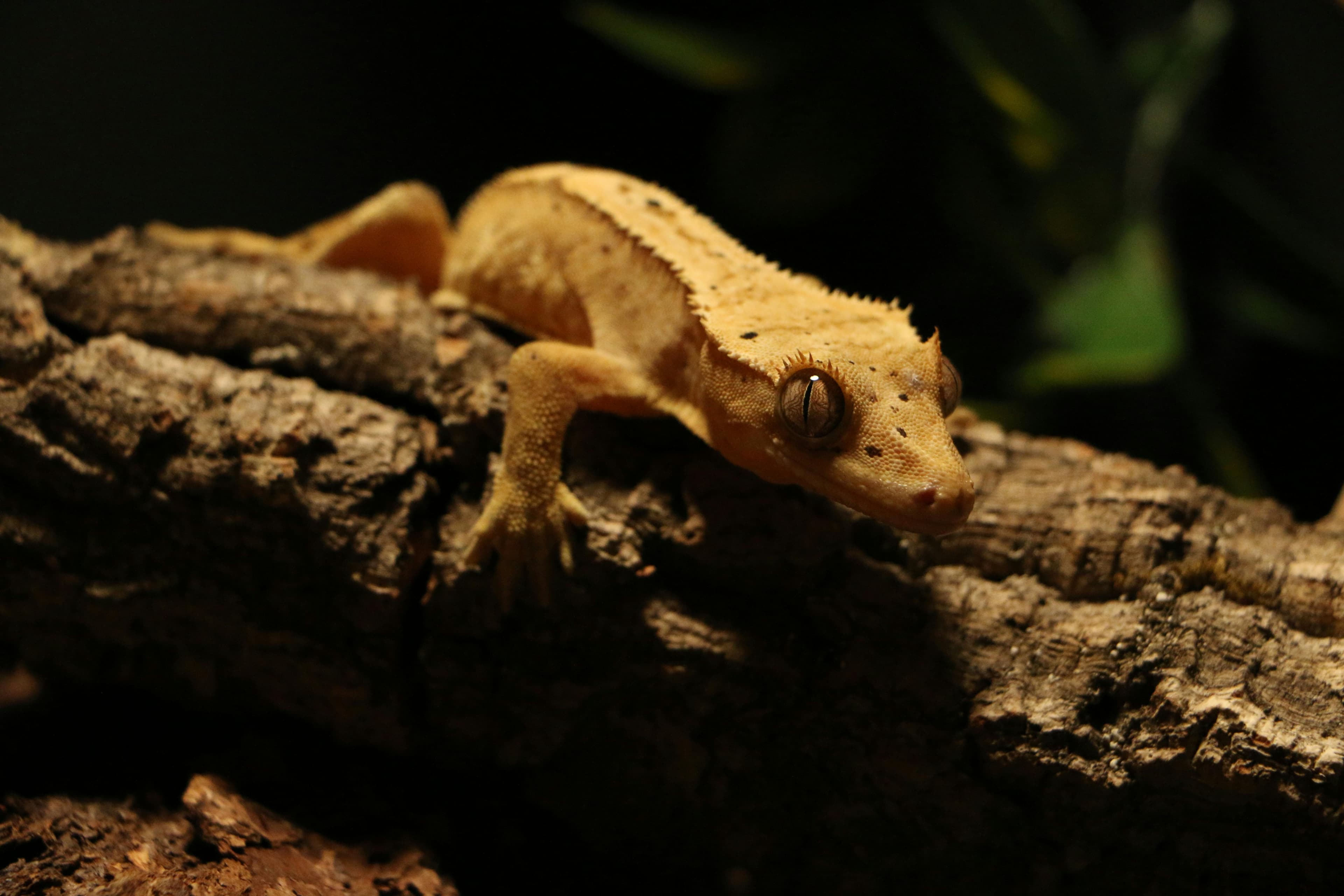
crested gecko
Correlophus ciliatus
an arboreal, nocturnal gecko from new caledonia. low-maintenance feeding, vertical enclosure, heat-sensitive.
photo on pexels
difficulty
beginner
adult size
20–25 cm including tail, 35–55 g
lifespan
15–20 years
origin
humid forests of new caledonia
00 / overview
about
crested geckos are nocturnal arboreal geckos from the humid forests of new caledonia. presumed extinct until rediscovered in 1994. they are now one of the most-kept reptiles in the hobby because the diet is a single powdered formula mixed with water, and they thrive at room temperature without a heat lamp in most homes.
what makes them genuinely low-maintenance: a complete powdered diet (CGD) replaces live feeders for most keepers, room temperature suits them, no brumation, no specialized lighting requirements were taught for years (though that is shifting). what trips first-time keepers: heat. they are heat-sensitive and easily killed by temps above 30 c, so a basking lamp or hot summer room is a real risk. also, they cannot regrow a dropped tail, so handling stress is genuinely consequential here in a way it is not for leopard geckos.
read the husbandry block below. every line is load-bearing.
01 / setup
enclosure
- type
- glass
- minimum dimensions
- 45 × 45 × 60 cm
- substrate
- coco husk, coco fiber, sphagnum moss, or bioactive (coco soil + sphagnum + leaf litter + isopods + springtails). paper towel for juveniles or quarantine. no loose sand, no pine, no cedar.
45 × 45 × 60 cm (18 × 18 × 24 in) is the floor for a single adult. 45 × 45 × 90 cm (18 × 18 × 36 in) is preferred. vertical orientation, not horizontal: they are arboreal. furnish heavily with cork bark slabs (angled, not just vertical), magnetic ledges, vines, branches, and live plants (pothos, bromeliads, ficus). live plants help hold humidity and give the gecko cover. floppy tail syndrome is the husbandry consequence of bare glass walls without enough horizontal perching.
02 / climate
temperature, humidity, uvb
temperature
cool side
20–24°c
warm side
22–26°c
basking
26°c
night drop to
18°c
humidity
50–70%
uvb
- bulb
- arcadia shadedweller pro t5 7 % or zoo med reptisun t5 ho 5.0, 50 % length of tank
- target uvi
- 1
- photoperiod
- 12 h / day
never exceed 28 c. they are heat-sensitive; temps above 30 c can be fatal. room temperature usually works without a heat source; in cool homes, a low-wattage deep heat projector on a thermostat is safer than a basking bulb. uvb is increasingly endorsed at ferguson zone 1 (uvi 0.5–1.0), softening the older "no uvb needed" line. mist morning and evening to bring humidity to 70 %+, then let it drop to 50–60 % during the day. standing wet substrate causes scale rot.
03 / nutrition
diet
feeders
- pangea complete crested gecko diet (cgd)
- repashy superfoods crested gecko diet
- black panther zoological crested gecko diet
- live dubia roaches (weekly enrichment)
- live crickets (weekly enrichment)
- live black soldier fly larvae (weekly enrichment)
feeding frequency
complete CGD fresh, 2–3× per week. mix with water to a thick smoothie consistency (typically 1 part powder : 2 parts water). offer in a shallow dish on a feeding ledge. replace uneaten food every 24–48 hours, do not let it dry out and stay in the enclosure. live insects 1× per week as enrichment, gut-loaded and lightly dusted with calcium + d3.
supplementation
- calcium + d3 (on live feeders only)every live-feeder day
- multivitamin (on live feeders only)1× per week
a complete CGD is the staple. it contains all the vitamins, minerals, and calcium needed; do not supplement on top of it. baby food, plain fruit, mashed banana, or "homemade" mixes are not adequate and cause mbd over time. live insects are optional enrichment, not required. feeders no wider than the space between the eyes.
04 / interaction
handling
frequency
short 5–10 min sessions, 1–2× per week once habituated. give a new gecko 2–3 weeks of minimal disturbance first, longer than most reptiles.
they are jumpers, not climbers-onto-the-handler. handle low to the ground or over a bed, expect leaps. never grab the tail, it drops and does not regrow. signs to back off: barking or chirping, gaping, jumping repeatedly, going limp. children should not handle unsupervised, the jump-and-drop response is unpredictable.
08 / red flags
common health issues
metabolic bone disease (mbd): from inadequate calcium / d3 supplementation when fed an incomplete diet (baby food, plain fruit, mealworms only), or from chronic feeding of live insects without dusting. signs: kinked spine, soft jaw, wavy bones, reluctance to climb, floppy tail syndrome (see below). preventable with a complete CGD as the staple. requires an exotic vet, often irreversible if advanced.
floppy tail syndrome (fts): spinal and pelvic deformation caused by extended head-down posture on flat vertical surfaces, often combined with sub-optimal calcium intake. signs: tail bends sideways when the gecko hangs head-down, visible kink at the base of the tail, eventual pelvic deformity. preventable with plenty of horizontal climbing options (vines, branches, cork bark slabs angled), not just flat glass. early cases improve with husbandry changes, advanced cases are permanent.
dehydration: from inadequate misting or low humidity. signs: wrinkled skin, sticky-looking eyes, lethargy, retained shed in patches. fix: mist enclosure twice daily (morning and evening), provide a shallow water dish, ensure humidity hits 70 %+ briefly after each misting then drops back to 50–60 %.
tail loss (autotomy): crested geckos drop their tails when severely stressed or grabbed. unlike leopard geckos, the tail does not regrow. the gecko is otherwise healthy without a tail, but the loss is permanent and the gecko''s nickname "frog butt" describes the post-loss appearance. handle carefully and never grab the tail.
impaction: from ingesting loose substrate (coco fiber, soil) while striking at feeders. signs: refusal to eat, no defecation for several days, bloated abdomen. emergency. feed CGD in a small dish, not smeared on a feeding ledge with substrate nearby, and offer live feeders in a separate, substrate-free area.
scale rot / bacterial dermatitis: from prolonged contact with damp substrate or standing water. signs: blackened or soft patches on the belly or feet. fix substrate moisture immediately, see an exotic vet for any open lesions.
09 / sourcing
where to get one
prefer captive-bred (cb) from a reputable breeder. crested geckos have been captive-bred at scale since the late 1990s and the wild trade is now closed (new caledonia bans export), so any "wild-caught" listing is almost certainly mislabelled or illegal.
ask for: hatch date, weight, parents'' morph history (crested gecko morphs are visual and well-documented), and confirmation of consistent CGD feeding. avoid: animals with floppy tail syndrome (visible spinal curvature when held upside-down), retained shed on toes, sunken pelvic bones (sign of mbd), or any history of dropped tail (the trait can be partially heritable). expect to pay 60–200 usd for a normal-morph cb juvenile, more for designer morphs. they live 15+ years, plan accordingly.
06 / questions
common questions
07 / references
sources
- pangea reptile — crested gecko care guideaccessed 2026-05-11
- reptifiles — crested gecko care guideaccessed 2026-05-11
- lafeber vet — crested gecko basic careaccessed 2026-05-11
- arcadia reptile — lighting guide (ferguson zones, uvi targets)accessed 2026-05-11
- msd veterinary manual — gekkonid lizardsaccessed 2026-05-11
provenance
- written by
- caresheet.app editorial
- reviewed by
- caresheet.app editorial, reviewed against 2024 reptile-keeper consensus (pangea reptile, reptifiles, lafeber vet, arcadia reptile lighting guide, msd veterinary manual)
- reviewed
- may 2026
- last updated
- may 2026
your animal
start a caresheet for your crested gecko.
species defaults pre-filled. edit what's yours. share when it matters.
11 / related species